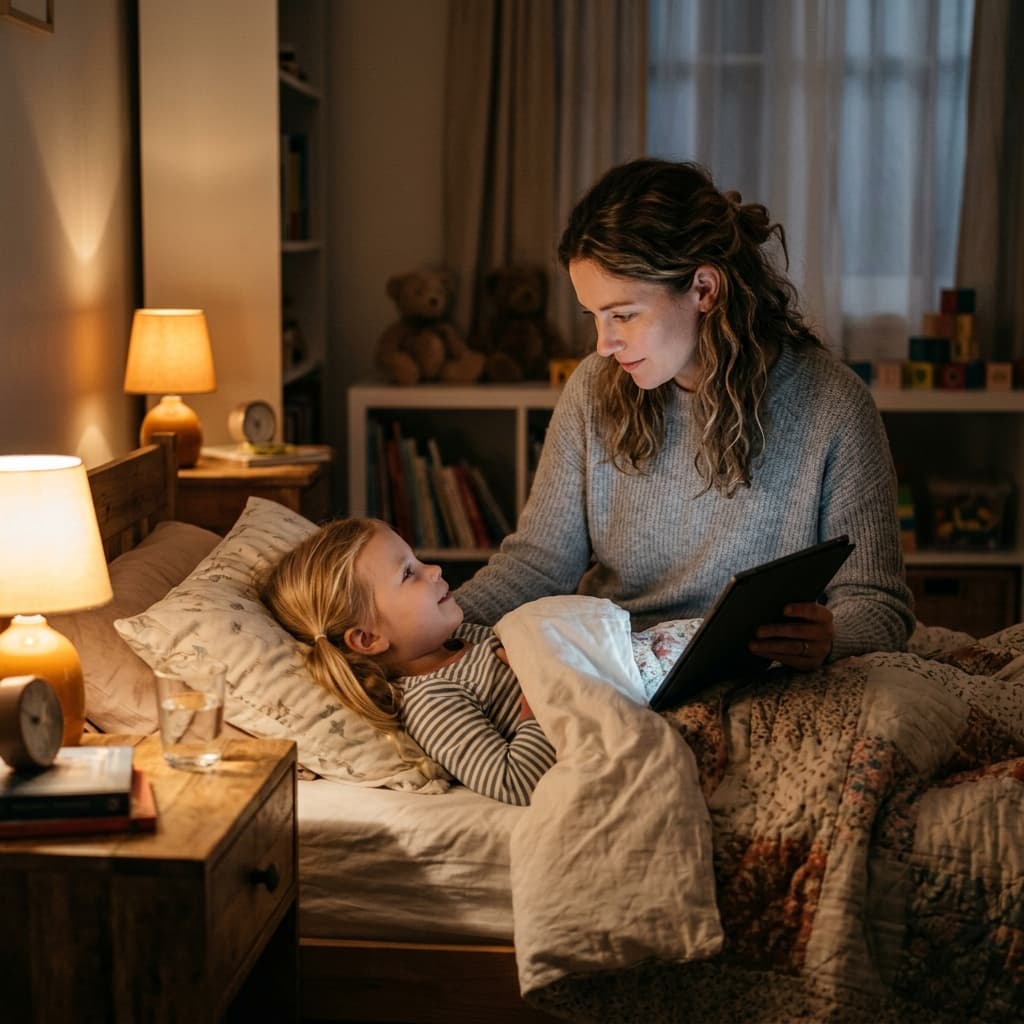
The word 'screen time' often comes with a side of guilt. We're told that blue light and flickering pixels are the enemies of a good night's sleep. But there is a vital distinction to be made: is the screen a passive distraction, or is it a storyteller's tool?
At Imagine My Story, we believe the device should be the script, not the show. When used correctly, a tablet doesn't replace the magic of a book—it enhances your ability to deliver it.
The Power of 'Joint Attention'
Research from the University of Michigan, led by Dr. Jenny Radesky, suggests that the most important factor in a child's media use isn't the device itself, but the interaction around it.
Experts call this 'Joint Attention'—the shared focus of two people on the same thing. When you sit with your child and use a device to read a story, you are practicing 'Co-viewing.'
In this model, the child isn't staring passively at a screen; they are listening to your voice, watching your expressions, and building mental imagery. The screen provides the prompt, but you provide the developmental value. It transforms the tablet from a 'digital babysitter' into a bridge for connection.
Three Rules for Storyteller-Led Screen Time
To keep the focus on the connection and off the pixels, try these three simple rules:
1. Screen for You, Story for Them Position the device so it’s your personal storyteller’s guide. By keeping the screen in your line of sight while your child focuses on your voice, you create a space for their imagination to flourish. They aren't watching a screen; they are watching the story unfold in their mind's eye as you bring it to life.
2. Dim to the Minimum Turn the brightness down as low as possible while still being readable. Most modern devices also have a 'Night Shift' or 'Warm' mode. This isn't just about sleep hormones; it's about setting the mood. A dimly lit screen feels less like a 'gadget' and more like a storyteller's lantern.
3. Let the Voice Lead The magic isn't in the screen—it's in the character voices you create and the pauses you take. Use the device as your prompt, but keep your eyes on your child as much as possible. When they see you looking at them while telling an extraordinary tale, the device disappears, and the story takes flight.
No account needed. Your first story is free.
From Distraction to Connection
The goal isn't to fight the presence of technology in our homes, but to master it. When you use your device as a digital storybook—a tool that empowers you to tell better, more personalized stories—it stops being 'screen time' and becomes something much more traditional: oral storytelling for the modern age.
You are the narrator. You are the hero. The screen is just there to help you remember the words.
Ready to try it?
No account needed. Your first story is free.
Try It Free — Create Your Child's First Story